1. Read the first field
Count one ordinary symbol type across the field. In this example eight A symbols occupy distant positions.
The Tumble Guide · Original game
Follow a round without confusing a replacement field, intermediate payment and completed result.
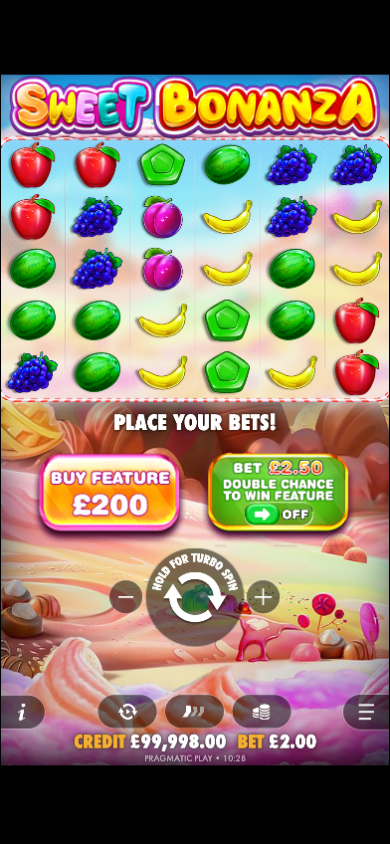
Find a single ordinary symbol type and count it across the six-by-five field. The original supplier description starts at eight matching symbols anywhere. A line is not required, and different symbols do not merge simply because their colours match.
At this point you are asking what the current field contains. Keep that separate from the credit balance and the result display. Those numbers describe funds and payments, not the count of symbols on the board.
A paying collection disappears and new symbols fall into the empty positions. The refill is part of the game’s tumble sequence. It is not a request for you to tap the start control again.
Notice which symbols remain and which have been replaced. The refreshed field can create another payment. Read it using the same ordinary rule, and do not carry symbols that disappeared into a new matching count.
A changing win display can be part of a result that is still developing. Follow the sequence until the game has completed its animation and is ready again. Only then compare stake, settled payment and remaining virtual credit.
This matters even if the balance has already changed. A stake can be deducted before a later payment is added. An early debit and the final net change can therefore be different observations.
Read one symbol type across the field.
A paying set disappears.
New symbols fall into the spaces.
Wait for the complete sequence.
An arithmetic example makes the distinction visible. Start with 50 virtual units, use a 1-unit stake and receive a settled payment of 0.25. The final balance is 49.25. The payment occurred, but it did not cover the stake.
These are invented teaching numbers. They are not a captured Sweet Bonanza result, a prediction or evidence of cash earnings. Use the actual labels and settled values when reading a real practice round.
The free-spin feature introduces another rule layer. Its Scatter trigger and multiplier calculation should be read in the game’s information rather than inferred from the ordinary symbol sequence. This guide does not require you to play until that feature appears.
Once you can explain count, clear, refill and settle, the learning task is complete. You can stop there or read the feature explanation with the demo closed. Neither path changes future game probabilities.
Original Sweet Bonanza · visual guide
Move through the reading decisions in order: count, clear, refill, settle. The next button advances the explanation; it never starts a spin.
Count one ordinary symbol type across the field. In this example eight A symbols occupy distant positions.
The winning combination vanishes; surviving symbols remain. This illustration marks the eight cleared positions with a dot.
Replacement symbols fall into empty positions, creating a field to read again. A new paying set can continue the sequence.
When no further winning combination appears, the tumble sequence finishes. Keep the completed round result separate from the next round.
Teaching sequence only. Letters and dots illustrate positions; it is not a game capture, an animation of a checked win or a prediction. All four stages remain readable without JavaScript.
Mechanics: original product summary and 2019 release, rechecked 29 October 2026. Diagrams are teaching examples; the reference images retain their 21 October 2026 EN / GBP demo settings.
Original Sweet Bonanza · visual guide
This arithmetic example explains the operation and timing. It does not model feature frequency, a payout or a future game result.
The original feature summary describes addition of multiplier values when its tumble sequence ends. Adding 2 and 5 gives 7; multiplying them would give 10 and uses the wrong operation.
Choose example feature values:
| Moment | What to read |
|---|---|
| While symbols are still tumbling | The current sequence is still in progress |
| At the sequence end | Add the feature multiplier values |
| After the result settles | Read the client’s completed result in its actual units |
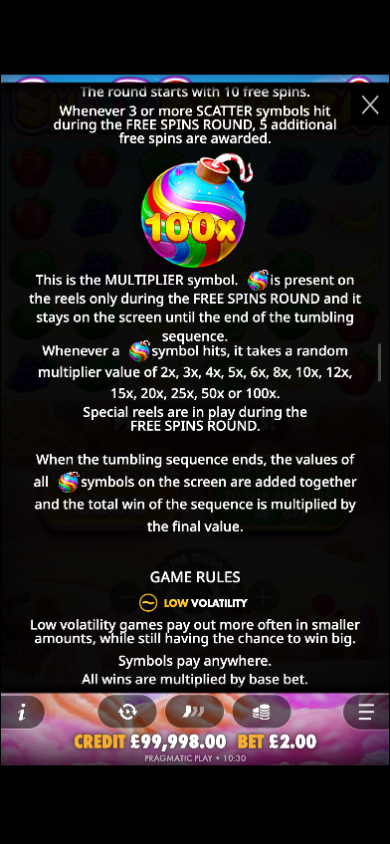
Mechanics: original product summary and 2019 release, rechecked 29 October 2026. Diagrams are teaching examples; the reference images retain their 21 October 2026 EN / GBP demo settings.
Game identity and feature summary checked 21 October 2026. Current operator settings, access conditions and promotions require their own checks.
The original release’s historical prize-potential wording is not used here as a verified current maximum. No universal RTP, stake range or casino bonus is asserted.